 Dignavia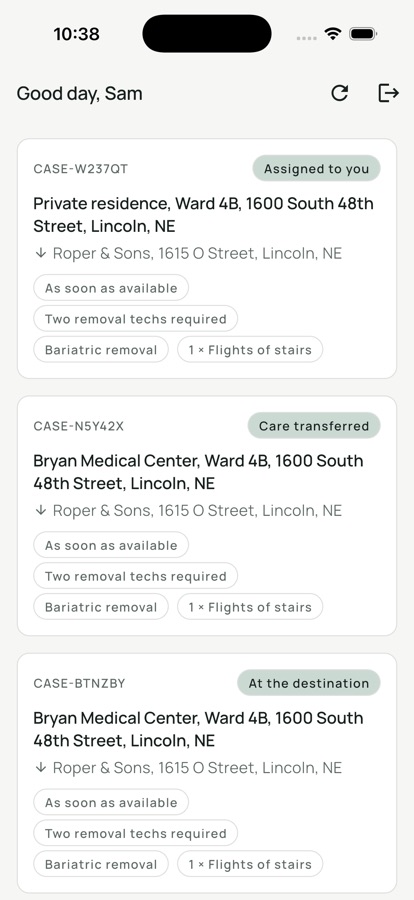
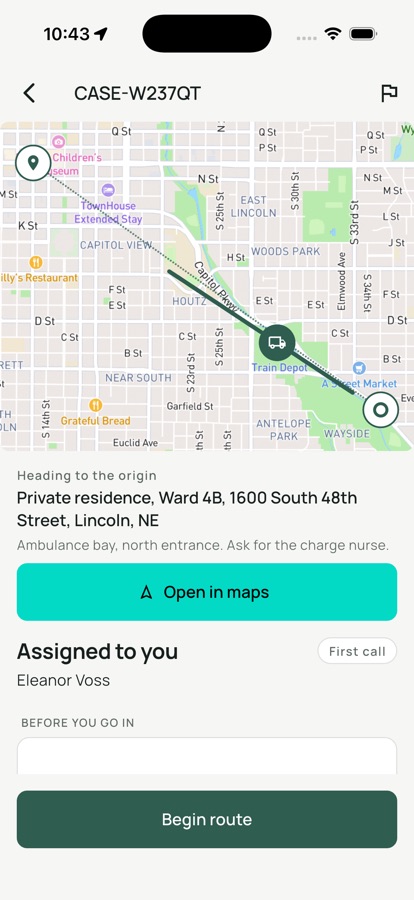
Removal tech
Their own cases, and nothing else
Weight, stairs, whether there is an elevator, how many hands it needs. Knowing before you arrive is what keeps a removal quiet and steady in front of a family.
Dispatch and chain of custody
For trade services and removal companies, and the funeral homes they work for. A first call opens a case, and every step after it is recorded on the device it happened on, at the moment it happened. Not so anyone can be second-guessed, but so that whoever asks what happened can be told, exactly.
Both stores shortly. There is no sign-up screen: talk to us and we set your organization up with you, on the phone, in an afternoon.
The app
The same app serves everybody who touches a removal, and each of them gets a different shape of it.
Removal tech
Weight, stairs, whether there is an elevator, how many hands it needs. Knowing before you arrive is what keeps a removal quiet and steady in front of a family.
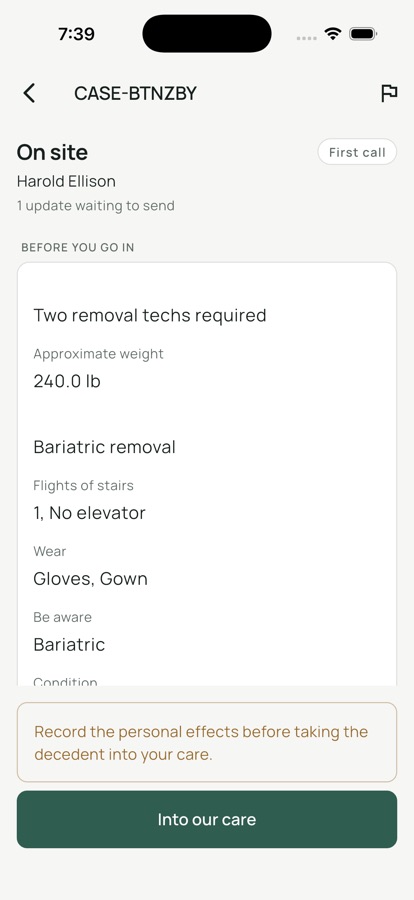
On site
The phone knows which step is next and offers only that. If the effects inventory is outstanding, it says so instead of giving you a button that does nothing.
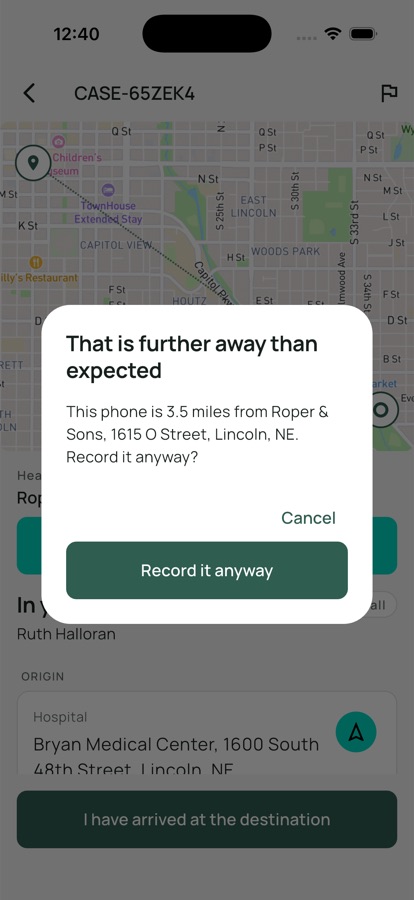
Judgment
An arrival recorded miles from the destination is questioned once, then recorded either way, with the distance kept on the record. The person who is actually there decides.
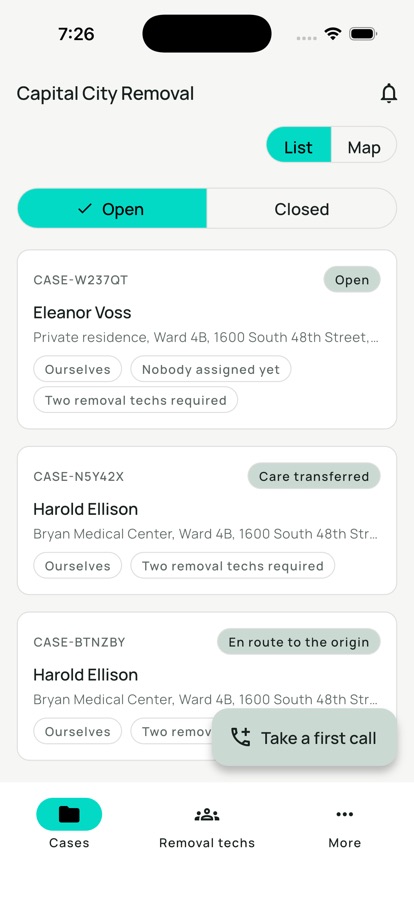
The desk
Take a first call, assign a tech and a vehicle, watch the board. On a map when you have a map source, and a list that says so plainly when you do not.
The record
Every step carries the moment it happened and the handset that recorded it. Nothing in it can be edited afterwards, by anybody, including us. A mistake is answered by a correcting entry that names the one it corrects, so the record is added to rather than tidied.
Hand the whole of it over as a PDF, every time in one zone and said plainly, whether it is a family asking or a coroner.
Who sees what
Not a setting on a shared screen. Three separate shapes, and the line between them holds.
Takes the first call, sees who is free, assigns a tech and a vehicle, watches the board, closes the month. Rates, statements, clients and the roster live here and nowhere else.
Never a case belonging to another organization.
One case, one action at a time, and everything needed to do it safely: weight, stairs, elevator, what to wear, what is waiting at the door. The map leads while they drive.
Never money, and never a case that is not theirs.
The state of their own case, how many minutes away it is, and the complete record once it closes. Nothing operational, and nobody else’s work.
Never a coordinate, a tech’s identity, an access note or a rate.
Money, and the numbers under it
Each leg records the method behind it: summed from the route the phone recorded, a routing service, or a straight line adjusted for roads. A person can overrule it, and the record says they did. A leg nobody could measure bills nothing.
A new card supersedes the last rather than overwriting it, so a month closed in March can still be repriced from March’s rates.
Enforced by the database, not by good intentions. A wrong charge is answered by an adjustment that points at it; a wrong statement by a correcting one.
Dignavia records what was charged and what has been settled, and keeps the ledger honest about the rest. It never sits in the middle of a payment.
Quantity and rate on every line, less the miles the card includes. A total nobody can check is a dispute waiting to happen.
Getting it
Not a slide deck. One case walked end to end, with the radio switched off halfway through. Bring one you remember: three in the morning, up a narrow staircase, a ring on the decedent’s hand that nobody wanted to be the one to lose.
No sign-up screen, on purpose. Accounts are created with you, so the first case you run is your own, on your own rates.
Take a first call and open a case.
Assign a removal tech and a vehicle.
Watch it land on the phone: stairs, weight, what to wear.
Turn on airplane mode.
Record the effects and take the releasing signature anyway.
Radio back on, and the chain arrives in sequence.
Export the complete record as a PDF.